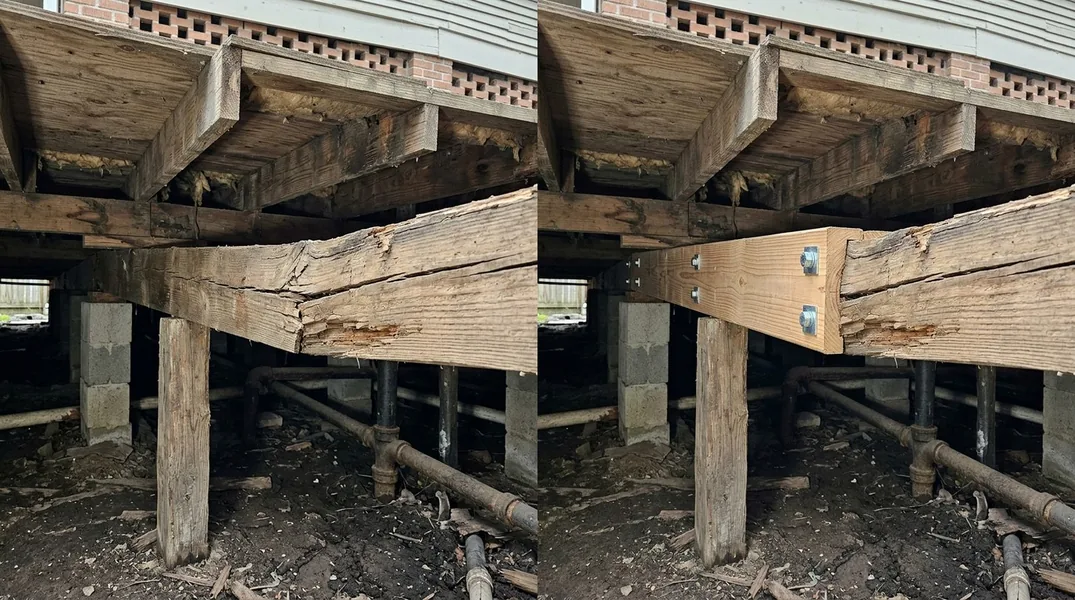
Why Old Houston Homes Develop Sagging Floors
If you own an older home in Houston, you've probably noticed that the floor feels slightly uneven underfoot. That subtle dip or bounce isn't just annoying, it's a warning sign. Sagging floors are one of the most common structural complaints we hear from homeowners with pier-and-beam foundations, and understanding what causes them is the first step toward fixing the problem.
Pier-and-beam foundations, common in Houston's older neighborhoods, sit on concrete piers spaced across the ground with wooden beams and joists supporting the structure above. Over decades, these wooden components can fail for several reasons. Wood Rot & Dry Rot Repair is one of the leading culprits, especially in Houston's humid climate. When moisture accumulates under the home, wood begins to decay from the inside out, weakening the structural integrity of beams and joists. Additionally, Termite Damage Repair needs are common here, as termites tunnel through wood and create hollow sections that can't support weight. Foundation settling, inadequate ventilation, and the natural aging of materials all contribute to the problem.
Understanding Pier-and-Beam Foundation Repair Basics
Before you can fix a sagging floor, you need to understand the system beneath it. A pier-and-beam foundation consists of concrete piers (posts) set into the ground at regular intervals, with wooden beams running horizontally across them. Floor joists sit on top of these beams and support the subfloor and finished flooring. When one or more components fail, the entire system loses support, and the floor sags in that area.
The repair approach depends on what's actually failing. If the piers have settled or shifted, Beam Replacement & Load-Bearing Wall Removal work may be needed to reset or replace the piers themselves. However, if the problem is rotted or damaged beams and joists, the focus shifts to restoring those wooden members. This is where Floor Joist & Subfloor Repair becomes essential. A professional inspection can pinpoint whether the issue is foundation movement, wood decay, pest damage, or a combination of factors.
Floor Joist Repair and Sistering Joists: What Homeowners Need to Know
One of the most effective and cost-efficient solutions for sagging floors caused by damaged joists is sistering. Sistering floor joists is a repair technique where a new piece of lumber (called a sister joist) is fastened alongside a damaged or weakened joist. This reinforces the weakened member and restores its load-carrying capacity without requiring complete replacement. The sister joist is typically bolted or lag-screwed to the existing joist at regular intervals, creating a composite beam that's stronger than either piece alone.
This method works well when the original joist still has some structural integrity but has been compromised by rot, termite damage, or age. The sister joist distributes loads more evenly and prevents further sagging. However, sistering isn't always the right answer. If a joist is severely rotted or hollow from termite damage, complete replacement may be necessary. A qualified carpenter will assess the damage and recommend whether sistering is sufficient or if full joist replacement is needed. The key advantage of sistering is that it's typically faster and less disruptive than removing and replacing the entire joist, which means lower labor costs and less disruption to your home.
Real Costs: What to Budget for Sagging Floor Repair in Houston
Homeowners often ask about pricing for floor repair work, and the truth is that costs vary widely depending on the scope of damage and the repair method chosen. A simple sistering job on one or two joists might cost between $800 and $2,500, while more extensive repairs involving multiple joists, beam replacement, or foundation work can easily exceed $5,000 to $15,000 or more. The variables that affect cost include the number of joists affected, the severity of rot or damage, accessibility under the home, and whether additional foundation work is needed.
In Houston, where humidity and termites are constant concerns, preventive measures and early intervention can save thousands in repair costs down the road. If you catch wood rot or termite damage early, repairs are less extensive and less expensive. If you wait until the floor is noticeably sagging, the damage has typically spread to multiple joists and beams, requiring more comprehensive (and costly) repairs. This is why getting a professional inspection at the first sign of trouble makes financial sense. Houston Carpentry offers a free estimate so you know exactly what you're facing before committing to repairs.
When to Call a Professional for Floor Joist and Pier-and-Beam Repair
Not all floor sag is an emergency, but it's never something to ignore. If you notice a gradual slope in your floor, hear creaking sounds when you walk in certain areas, or see visible gaps opening up between walls and ceilings, these are all signs that your foundation or floor system needs professional evaluation. Some homeowners mistakenly assume minor sagging is just settling and will stop on its own, but the reality is that structural problems tend to worsen over time, especially in humid climates like Houston's.
A licensed carpenter can inspect the crawlspace or basement, measure the amount of sag, identify the root cause, and recommend the most appropriate repair strategy. This might involve sistering joists, replacing beams, treating wood rot, addressing termite damage, or adjusting foundation piers. The goal is to stop the sagging, restore structural integrity, and prevent future problems. If you're in Houston and concerned about your floors, don't wait. Call Houston Carpentry at (832) 462-7903 to schedule your inspection and receive a detailed assessment of what needs to be done.
Prevention and Maintenance to Protect Your Pier-and-Beam Foundation
The best approach to sagging floors is preventing them in the first place. If you own an older home with a pier-and-beam foundation, regular maintenance and moisture control are essential. Ensure that the crawlspace is properly ventilated to reduce humidity and prevent rot. Check for standing water or signs of moisture intrusion, and install or repair gutters and downspouts to direct water away from the foundation. Have your home inspected annually by a professional who can spot early signs of wood decay, termite activity, or foundation movement before they become major problems.
If you discover wood rot or termite damage during an inspection, address it immediately. Early intervention with Wood Rot & Dry Rot Repair or pest damage remediation can prevent the problem from spreading to floor joists and beams. Keeping your foundation dry, well-ventilated, and pest-free is far more cost-effective than dealing with extensive structural repairs years later. Houston Carpentry has helped hundreds of homeowners protect and restore their pier-and-beam foundations. If you're ready to address sagging floors or want to schedule a preventive inspection, contact us today for a free estimate or call (832) 462-7903.
Looking for a professional carpentry contractor in Houston? Houston Carpentry responds fast for all your carpentry needs.
Get a Free QuoteOur services: Wood Rot & Dry Rot Repair · Termite Damage Repair · Floor Joist & Subfloor Repair