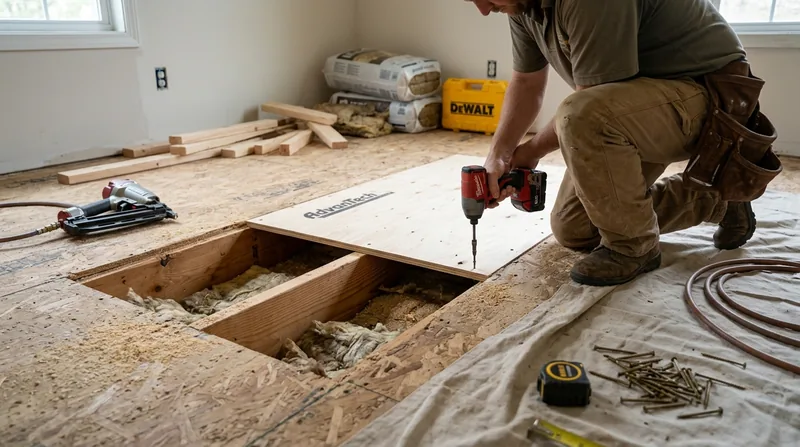




Sagging, bouncy, or soft floors in Houston homes often point to damaged floor joists or subfloor sections. The Gulf Coast's expansive clay soils, seasonal moisture swings, termite pressure, and the age of our housing stock combine to create real joist and subfloor damage. Older craftsman bungalows on pier-and-beam foundations in the Houston Heights, mid-century ranches across Meyerland and Spring Branch, and brick-veneer suburbs from Katy to Pearland all face similar structural wood challenges. Floor Joist & Subfloor Repair in Houston restores floor integrity, eliminates bounce, and levels surfaces before new finishes go down. We sister compromised joists, rebuild soft or rotted subfloor sections, and address the moisture or pest damage that caused the failure in the first place. The work is structural, requires clear thinking about repair versus replacement, and demands carpenters who know how to work within the constraints of existing framing and foundation systems.
Why Floor Joist and Subfloor Damage Matters in Houston
Houston's climate and terrain create ideal conditions for wood failure in floor systems. The region sits on flat Gulf Coast clay that swells in wet months and shrinks in dry spells, causing pier-and-beam foundations to move and flex. Slab-on-grade homes absorb moisture from below through concrete, wicking into rim joists and sill plates. Termites remain active year-round under our humid subtropical climate, targeting wood members below grade and in crawl spaces. When floor joists or subfloor rot, dry out, or suffer termite damage, the floor loses stiffness and support. Bounce gets worse over time, and soft spots can eventually lead to permanent sag or worse structural movement.
- Damaged joists lose bearing capacity and allow floors to deflect under normal foot traffic or furniture load.
- Rotted or soft subfloor sections no longer brace the joists and transfer loads to the rim and band board.
- Moisture trapped in crawl spaces or under slab edges accelerates wood decay in both new and old homes.
- Termite galleries hollow out joists and subfloor from inside, leaving the wood structurally hollow long before visible damage appears.
- Unaddressed floor movement can crack drywall, rack door frames, and damage finish flooring and tile.
Early repair stops the decay, restores floor stiffness, and costs far less than waiting for the damage to spread to rim joists, band boards, or load-bearing walls.
Key info: Homes in Tanglewood, River Oaks, and the Houston Heights built before 1970 on pier-and-beam foundations often develop joist damage in the 30-plus years following construction as wood ages and foundation settlement creates stress points. Newer tract homes in Katy, Sugar Land, and Pearland on slab-on-grade can develop rim joist rot where the concrete meets the wood framing, especially if drainage or grading has failed.
For official guidance on structural repairs and permitting thresholds, see the City of Houston Building Services website, which outlines when permits are required for joist or subfloor work.
How We Repair Floor Joists and Subfloor in Houston Homes
Our process begins with a thorough inspection of the crawl space, basement, or underfloor area to identify the source and extent of the damage. We document moisture, pest activity, and the condition of each joist and subfloor section. Once we understand the pathology, we propose the most cost-effective repair: sistering a damaged joist with a new pressure-treated or kiln-dried member, replacing a localized soft subfloor patch, or rebuilding an entire section if the damage is too widespread. We then address the underlying cause, whether that is drainage, ventilation, or a completed pest treatment from your own licensed pest control provider. Work proceeds methodically, with temporary support in place, and finishes with leveling and preparation for flooring or finish carpentry. See our Framing & Structural Carpentry page for more detail on how we approach structural wood repair.
- We inspect the full floor system, including rim joists, band boards, sill plates, and all visible subfloor sections.
- We identify the root cause of the damage: moisture intrusion, termite activity, wood decay, or foundation movement.
- We sister or replace joists using pressure-treated lumber or kiln-dried stock sized to match the original member.
- We rebuild or sister subfloor sections using exterior-grade plywood or tongue-and-groove boards matched to the original thickness and span.
- We install temporary support posts or adjustable posts to hold the floor level during work and prevent any drop or shift.
- We level the floor using shims, sister beams, or gradual joist replacement to restore a flat or near-flat surface.
- We restore ventilation and drainage to the crawl space or rim area to prevent future moisture accumulation.
This systematic approach ensures the floor is safe, level, and ready for new flooring or finish work without surprises or callbacks.
Example: A 1950s ranch home in Meyerland had three joists with visible rot in the crawl space and a soft spot in the subfloor directly above. We sistered the three joists with new pressure-treated 2x10s, replaced the soft subfloor section with new 3/4-inch tongue-and-groove, and installed a small sump pump and perimeter drain to manage the seasonal moisture that had triggered the decay. The floor returned to level, the bounce disappeared, and the homeowner avoided a far costlier foundation or structural repair down the road.
| Approach | Description | Best for |
|---|---|---|
| Sistering | Bolting a new pressure-treated or kiln-dried joist alongside a damaged member to restore load capacity and stiffness. | Joists with localized rot or decay that still have 50 percent or more of their original cross-section intact. |
| Full Joist Replacement | Removing a severely damaged joist and installing a new member sized and spaced to match the original framing. | Joists that are hollow, crushed, or rotted through more than half their depth or width. |
| Subfloor Patching | Cutting out a soft or rotted subfloor section and replacing it with new exterior-grade plywood or tongue-and-groove matching the original thickness. | Isolated soft spots or rot limited to 10 to 20 square feet with sound joists underneath. |
| Crawl Space Moisture Control | Installing vapor barriers, sump pumps, perimeter drains, or improving ventilation to dry the underfloor environment. | Homes where moisture is the root cause and preventing future damage is as important as repairing current decay. |
Floor Joist & Subfloor Repair Cost in Houston: What to Expect
Floor joist and subfloor repair in Houston typically starts at $1,800 to $2,500 for a small localized repair, such as sistering a single joist or patching a subfloor section under 15 square feet. Larger jobs involving multiple joists, extensive subfloor replacement, or moisture remediation climb into the $4,000 to $8,000 range or higher. The cost depends on the number of joists affected, the total area of subfloor to replace, access to the crawl space or underfloor area, the type of wood and lumber grade required, and whether moisture control or ventilation upgrades are needed. Homes in flood-prone areas, those with poor crawl space access, or those requiring temporary support during work often run at the higher end of the range. The best approach is to get two or three estimates from carpenters who will inspect the damage in person and explain what repair approach makes sense for your home and budget. See our pricing page for more detail on how we structure estimates and what factors move the cost up or down.
Why not just replace the whole floor? In most cases, the damage is localized to one or two joists and a small subfloor section. Sistering or patching costs a fraction of replacing the entire floor system and is structurally sound if the underlying wood is sound. We recommend replacement only when rot or decay is too extensive to repair safely or when the original framing is undersized for modern loads. Honest assessment of what the wood can support, not fear of liability, guides our recommendation.
Floor Joist & Subfloor Repair Near Me: What Houston Homeowners Should Know Before Hiring
Hiring a carpenter for structural floor repair requires the same care you would give to any major home repair. Look for a firm that is fully insured with general liability and workers' compensation coverage, has verifiable references from recent projects, and can explain the damage and the repair method in plain language. Ask whether the carpenter has experience with your home's age and type: pier-and-beam homes in the Heights and Tanglewood have different failure modes than slab-on-grade ranches in Katy or Pearland. Understand that structural repairs often require a permit from the Houston Building Department, especially if joists are being replaced or the floor is being leveled as part of a larger structural alteration. Don't assume a permit isn't needed just because the damage is hidden. Verify with the local building department or ask your carpenter to pull the permit. If your home is in an HOA community, check whether the HOA requires notice or approval for underfloor work. Get at least two estimates, and ask each carpenter to walk you through the work plan, timeline, and warranty on the repair. Call (832) 462-7903 for a free estimate with no obligation, and we will inspect the damage, explain what we find, and give you a clear price and timeline.
- Verify that the carpenter carries liability insurance and workers' compensation and ask for a certificate of insurance.
- Request references from three recent projects in your neighborhood or on a similar home type.
- Ask whether a permit is required and who will pull it, and understand that structural repairs commonly require city approval.
- Confirm that the repair includes leveling the floor and addressing the root cause of the damage, not just replacing the wood.
- Understand the warranty on the repair work and what follow-up is included if issues arise after completion.
- Get the estimate in writing with a clear scope, timeline, and total price, and ask about payment terms and when work begins.
A straightforward, professional repair should restore your floor to safe, level, and durable condition. Contact Houston Carpentry today to schedule your free inspection and estimate.
Floor Joist & Subfloor Repair in Houston: Pricing Guide
| Service | Price | Details |
|---|---|---|
| Single joist sistering or small subfloor patch | Starting at $1,800 | One damaged joist sistered or one subfloor section under 15 square feet replaced, includes labor and materials |
| Multiple joists or larger subfloor replacement | Starting at $3,500 | Two to four joists sistered or replaced, or 15 to 40 square feet of subfloor rebuilt, includes temporary support and leveling |
| Crawl space moisture control and floor repair | Starting at $4,500 | Floor repair plus vapor barrier, sump pump, perimeter drain, or ventilation upgrade to prevent future moisture-driven decay |
| Large-scale or complex repair | On estimate | Extensive joist replacement, whole-room subfloor rebuild, or structural leveling requires on-site inspection and engineering input |
| Travel and inspection | Included | No separate mileage or travel fee within Houston and surrounding service areas including Katy, Sugar Land, and The Woodlands |
| Free estimate | No obligation | Detailed inspection, written estimate, and timeline response within 24 hours at (832) 462-7903 |
Indicative pricing, the exact cost depends on square footage, finish, and site access. Free personalized estimate within 24h at (832) 462-7903.


